
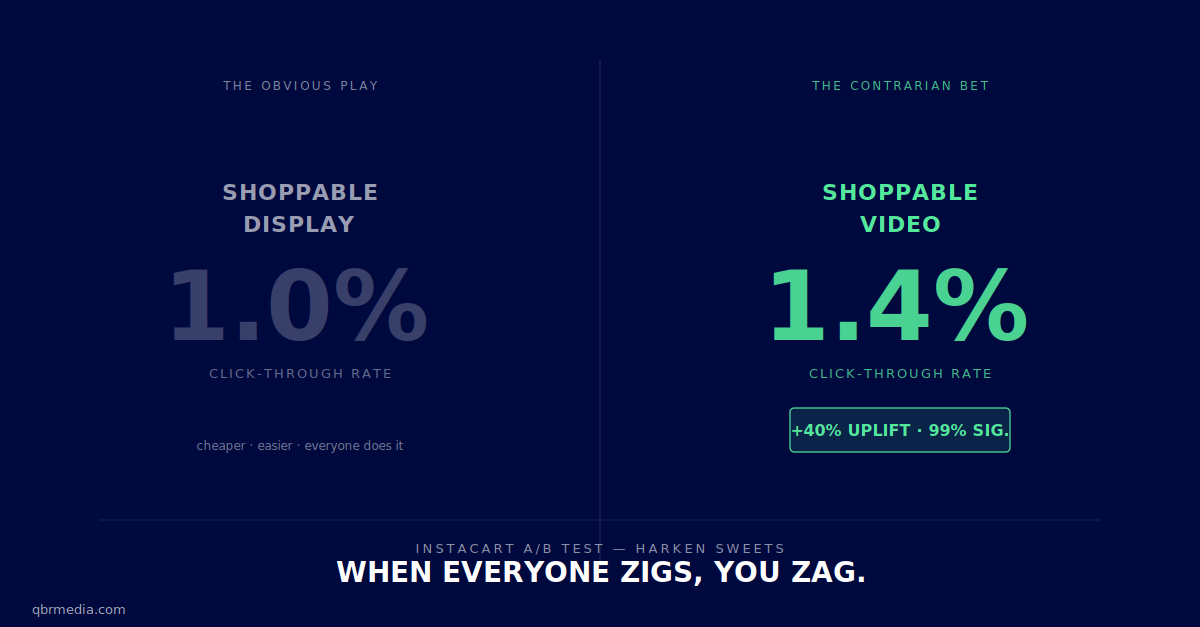
Most brands on Instacart run only Shoppable Display ads because static images are cheaper and easier to produce, so that’s what everyone does.
But that’s also exactly why Shoppable Video is worth testing. For Harken Sweets, we ran a creative A/B test between Shoppable Display and Shoppable Video. Besides the creative, everything else was identitical — same audience targeting, same product portfolio, and same CPM bids.
The result: Shoppable Video outperformed on CTR by 40% at 99% statistical significance.
Here’s our process.
For Shoppable Display, the goal is contrast.
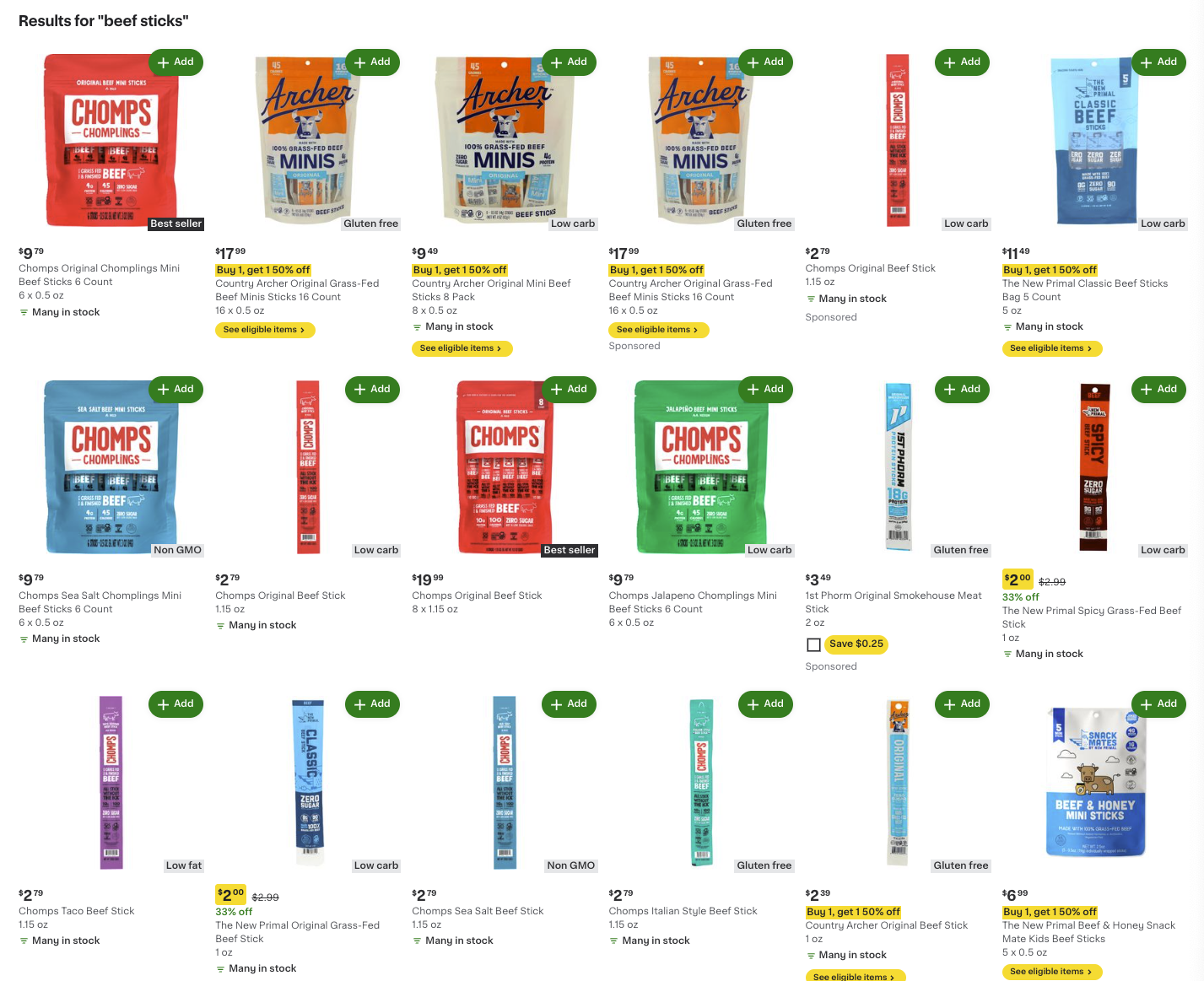
Start by searching your core category on Instacart and studying what already shows up.
For "beef sticks," for example, the shelf is dominated by brands with blue and green packaging — so a bright, high-contrast creative would stand out immediately. (Note: we're using Chomps as a category example here. Harken Sweets is the brand we tested with, but we're not sharing their creatives publicly)
The second principle is use what already works. And there’s no other platform that is best for creative testing than Meta.
The formats are different — Meta runs vertical, Instacart runs landscape, but the underlying question is the same: what stops a scroll? If a creative generates engagement on Meta, it will likely also work on Instacart.

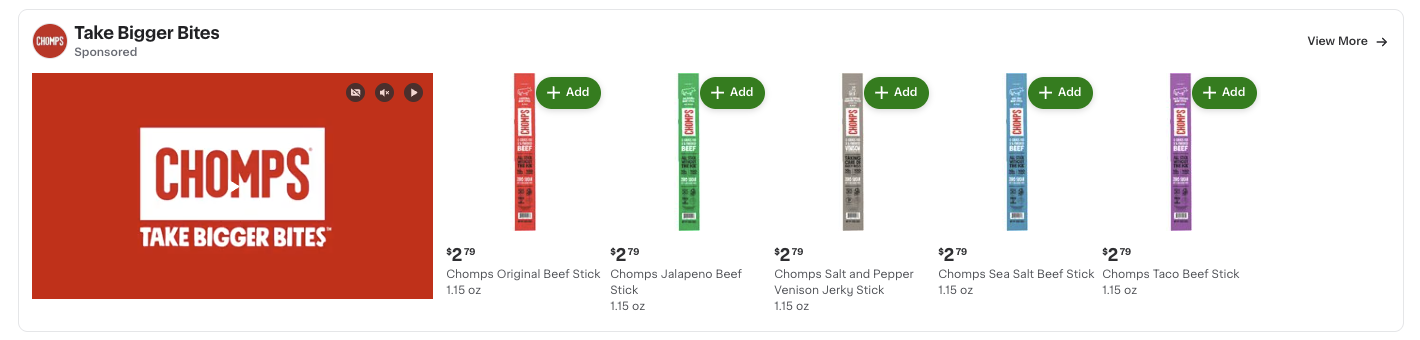
Combine those two pieces of advice together and you get a shoppable design creative that looks like below.
Want a swipe file of 100+ Instacart Shoppable Display examples organized by aisle? Check it out here.
We launched two separate campaigns.
One for Shoppable Display, and another for Shoppable Video.
Both with identical settings across everything else: audience targeting, product portfolio, and CPM bids. The budget was approximately $1,000 per creative, which is generally enough to reach statistical significance or surface a directional signal.
The Shoppable Display ad finished with a 1.0% CTR. The Shoppable Video came in at 1.4% — a 40% lift, at 99% statistical significance.
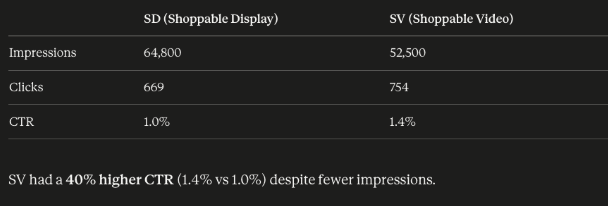

Standard testing protocol calls for >95% statistical significance before acting on results to be confident that there is sufficient sample size. So given we had a 99% statistical significance where the SV ad generated higher CTR% AND also had stronger ROAS performance, we declared the SV to be the new baseline creative & winner.
A 40% higher CTR is a massive win, especially when spending thousands per month generating hundred of thousands in impressions — a 40% increase in CTR will add up to a significant amount of additional engagement.
And that's only the people who click.
Most shoppers who see these ads won't convert in that session. But they still saw the ad. That passive exposure — a brand registering in someone's peripheral vision while they're actively shopping — builds recognition over time in a way that's real but hard to attribute. However this is hard to track on the dashboard, but the CTR% is the best proxy towards which ads actually drive awareness and engagement.

© Copyright 2026, All Rights Reserved
