

Being a true partner with our clients means more than scaling ad spend — it means making sure every dollar is working as hard as possible, even when that leads to uncomfortable conversations about budget reallocation.
For One Mighty Mill, a better-for-you bread brand, we suspected that reported ad performance on one platform was significantly overstating the actual sales impact of their ads.
Rather than accept inflated ROAS figures at face value, we designed a rigorous incrementality test to find the truth — and ultimately shifted their budget to where it would drive the most real growth.
One of the most common pitfalls in retail media is confusing ad-attributed revenue with incremental revenue.
Platforms naturally report the sales that touched an ad, but that includes purchases that would have happened anyway.With aggressive default attribution windows — for example, Target Roundel's default of 30-day click and 1-day view — reported ROAS can look impressive while actual lift remains minimal.
This is especially true for high-frequency, habitual purchases like bread, where repeat buyers will convert regardless of ad exposure.
For One Mighty Mill, Platform A was consistently reporting 10–15x ROAS at sizeable volumes of spend, at levels this high, it’s often too good to be true.
Fortunately, platforms like WFMOA (via Premium Insights Package), Walmart Connect (via platform reps), and Roundel (via Brokers) will provide “source of truth” data in the form of total digital/online sales.
Note: To protect client confidentiality, we refer to the platforms involved as Platform A and Platform B.
We designed a controlled incrementality test across three distinct spend periods, timed deliberately to avoid in-store promotions and seasonal noise:
Period 1 — Baseline: Normal spend levels to establish a performance benchmark
Period 2 — Reduction: Spend dropped dramatically to isolate organic sales volume
Period 3 — Scale: Spend restored (and increased) to measure the true lift from advertising.
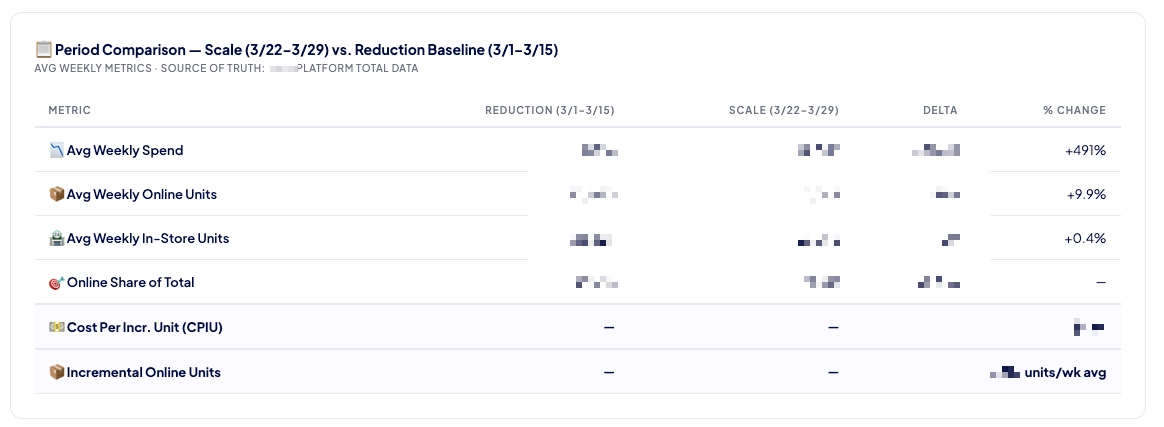
The weeks of 2/8–2/15 were on-promo, so we used 2/22 onward as our clean off-promo baseline. Spend was cut sharply starting 3/1, then scaled back up from 3/22.

When we dropped spend on Platform A, unit sales did decline — and when we scaled back up, they rose again. On the surface, this looked like ad responsiveness. But when we quantified the incremental change, the picture was far less impressive.

Despite a ~500% increase in ad spend, total online units sold increased by only ~10%. The cost per incremental unit (CPIU) was significantly higher than what we were seeing from other platforms — meaning Platform A's reported ROAS was largely reflecting organic demand, not ad-driven growth.
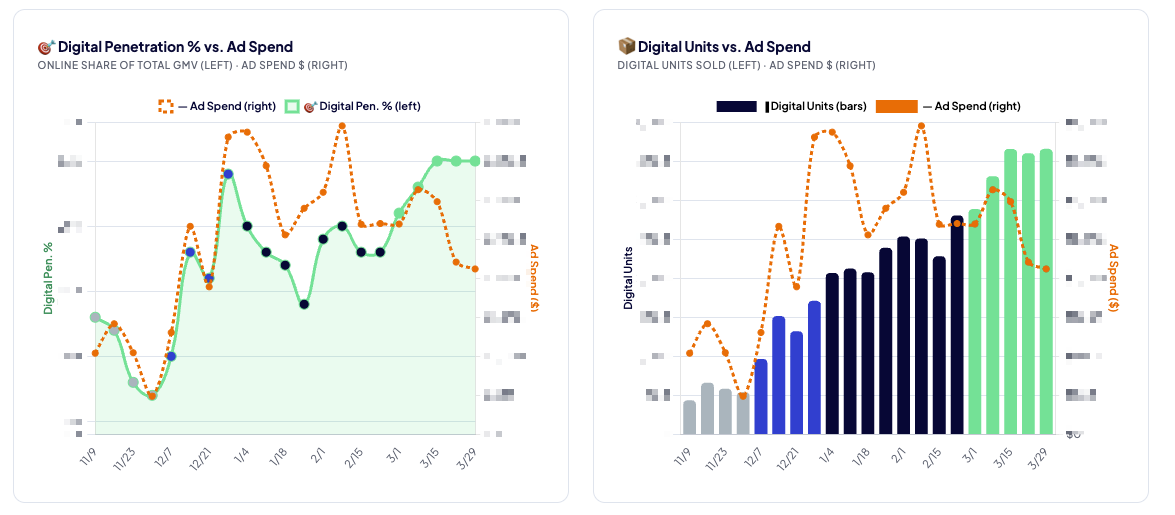
While Platform A showed minimal true lift, Platform B told a very different story. Analysis revealed a strong correlation (R = 0.71) between ad spend, digital unit sales, and digital penetration — meaning spend increases on Platform B were genuinely moving the needle. And it was doing so at a materially lower cost per incremental unit.
The data told a clear story, and our recommendation operated on two levels.
Tactically, we advised reallocating the bulk of incremental budget from Platform A to Platform B. This wasn't a complete pullback — Platform A still had a role to play — but with limited budget to deploy, every marginal dollar needed to go where it would drive the most real growth. Platform B's lower cost per incremental unit made that an easy call.

Strategically, the decision was just as sound. Platform A was already hitting its sales velocity targets, meaning it had reached a level of maturity where additional spend would yield diminishing returns. Platform B, by contrast, had meaningful headroom — it was underperforming against its targets, and the incrementality data confirmed that more investment there would actually move the needle.
For One Mighty Mill, this reallocation wasn't just a budget shuffle. It was a shift toward smarter growth — putting media dollars where they would generate real incremental unit sales, not just inflate the numbers on a reporting dashboard.
If your retail media ROAS looks too good, it might be.Incrementality testing is the most reliable way to separate signal from noise — and it's increasingly accessible across major platforms through premium insights packages and platform partnerships.
The best retail media strategy isn't the one that maximizes reported ROAS. It's the one that maximizes actual, incremental sales growth.

© Copyright 2026, All Rights Reserved
